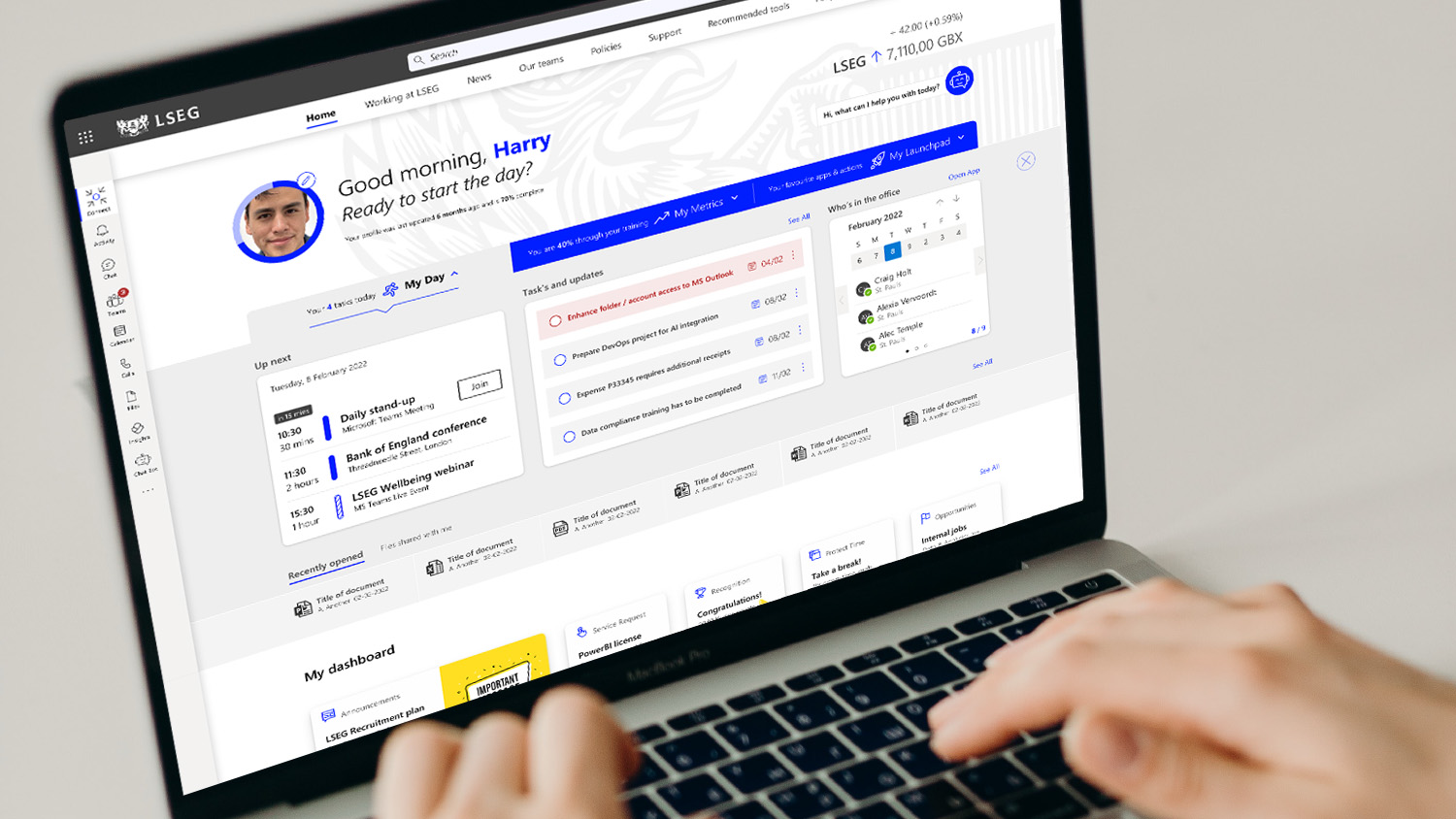

Digital Employee Experience Strategy and Design
Led the UX and UI design for a Digital Workplace hub, Knowledge Management strategy and roadmap, and communication channel definition and targeting approach for one of the world’s signature Stock Exchanges. Helping to bring together two companies after a merger between one very traditional old English company and a US financial market newcomer with very different employee cultures. Bowler hats vs. baseball caps meet and share. Design passed to their incumbent offshore systems integrator for build and rollout.
One Culture, One Workplace: LSEG’s Future Employee Digital Experience
London Stock Exchange Group needed to design a world-class, unified employee digital workplace to replace its ageing Connect intranet and knit together a sprawling, disconnected set of systems; Connect, Microsoft 365 and Teams, ServiceNow, Workday, news and knowledge systems and learning platforms, into one coherent experience for a newly combined organisation. LSEG had recently acquired Refinitiv, the American financial data upstart, creating a genuine clash of cultures: the centuries-old, traditional London Stock Exchange meeting Refinitiv’s brash, “everybody has a voice” New York culture. I led the experience and strategy design as an Accenture-badged engagement delivered by Avanade.
End-user workshops and SME interviews surfaced consistent, strongly felt frustrations with the existing intranet. Search was, in the words of one participant, “extremely poor”. The homepage was inflexible and overly image-heavy. Navigation relied on clunky drop-downs and heavy-handed security forced frequent reauthentication and sometimes blocked access to apps entirely. Content ownership and governance were unclear, much of the content was out of date and there was no consistent process to retire it, while would-be content creators had little training or support to publish anything better. Beyond Connect itself, the wider digital landscape was fragmented: employees had to bounce between Connect, Microsoft 365, Teams and various applications, with no single personalised place to work from.
Research captured this directly, in employees’ own words, both met with dead ends in the current experience:
“I need to find information on the team leading this initiative.”
“I need to see more content that is relevant to me, personalised to me.”
This mattered for reasons well beyond convenience. LSEG was navigating a generational shift toward hybrid, mobile-first working, in a post-pandemic world where the existing systems simply weren’t built for it. The Refinitiv acquisition had just reshaped the organisation, making a single unified employee experience a strategic priority rather than a nice-to-have and the cultural dimension of that was real and significant: bowler hats versus sneakers, a centuries-old institution merging with a brash, empowerment-driven New York startup. Persona research across business leaders, developers, content creators, content consumers and collaborators/community builders showed the same root problems recurring across every role: inefficient search, siloed information, low engagement and an overreliance on colleagues’ personal knowledge rather than any internal system. Left unaddressed, LSEG risked continuing to run poorly integrated systems, weak adoption of its Microsoft 365 investment and a missed opportunity to use the digital workplace to build one collective culture across the combined workforce. Knowledge management mattered especially here as it has real financial weight for a business like LSEG, shaping how effectively lessons learned translate into market listing and performance and LSEG already had a strong knowledge system on their side worth building on rather than replacing.
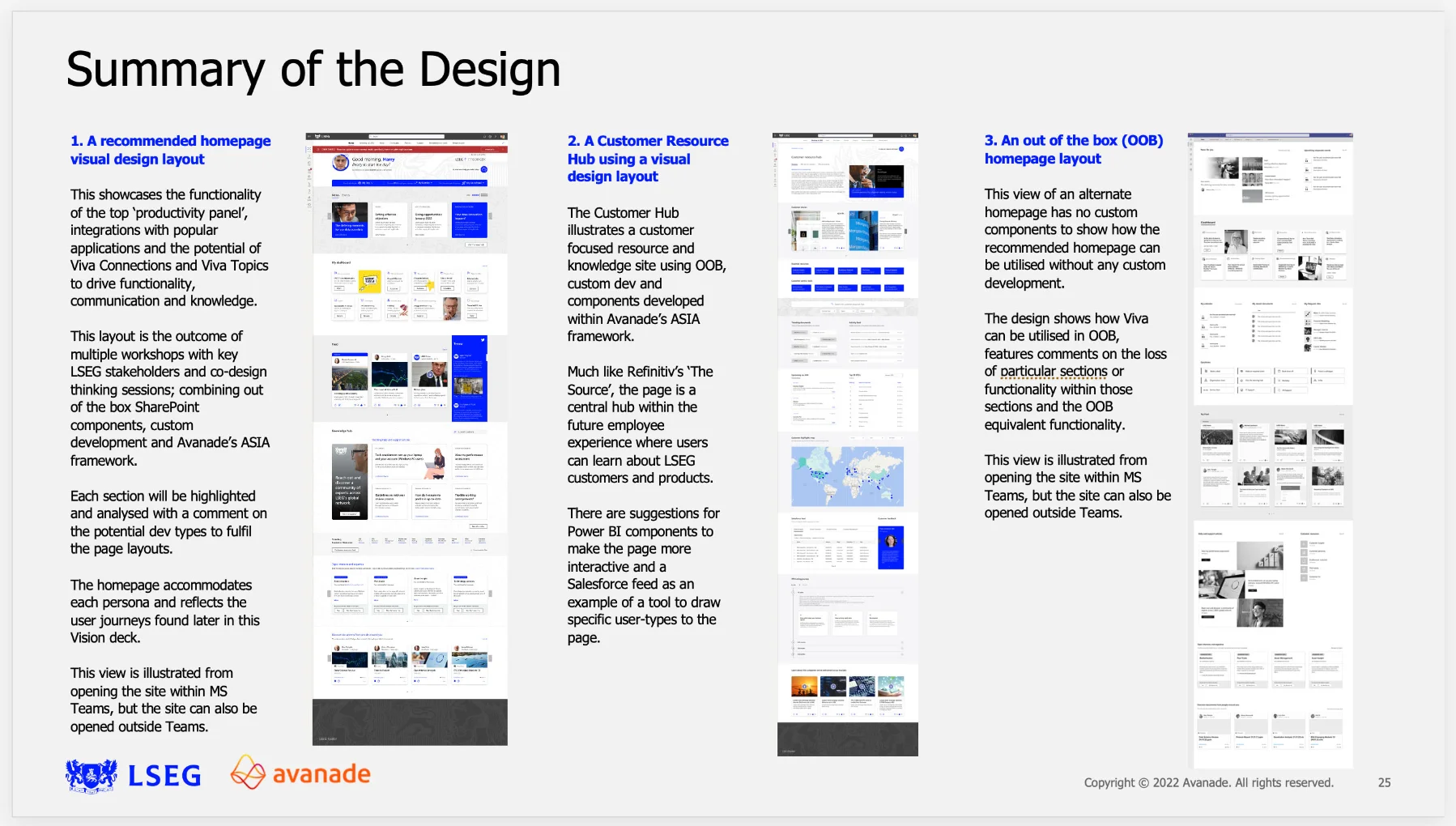
As creative director and UX lead, I led the design response to LSEG’s brief — shaping the co-creation journey (Discover, Describe, Design) and directing the visual design and branding work running alongside the research and strategy streams. I contributed to research planning and Q&A and helped shape the findings, which were run by the advisory team, and I planned and led all workshops and co-design sessions.
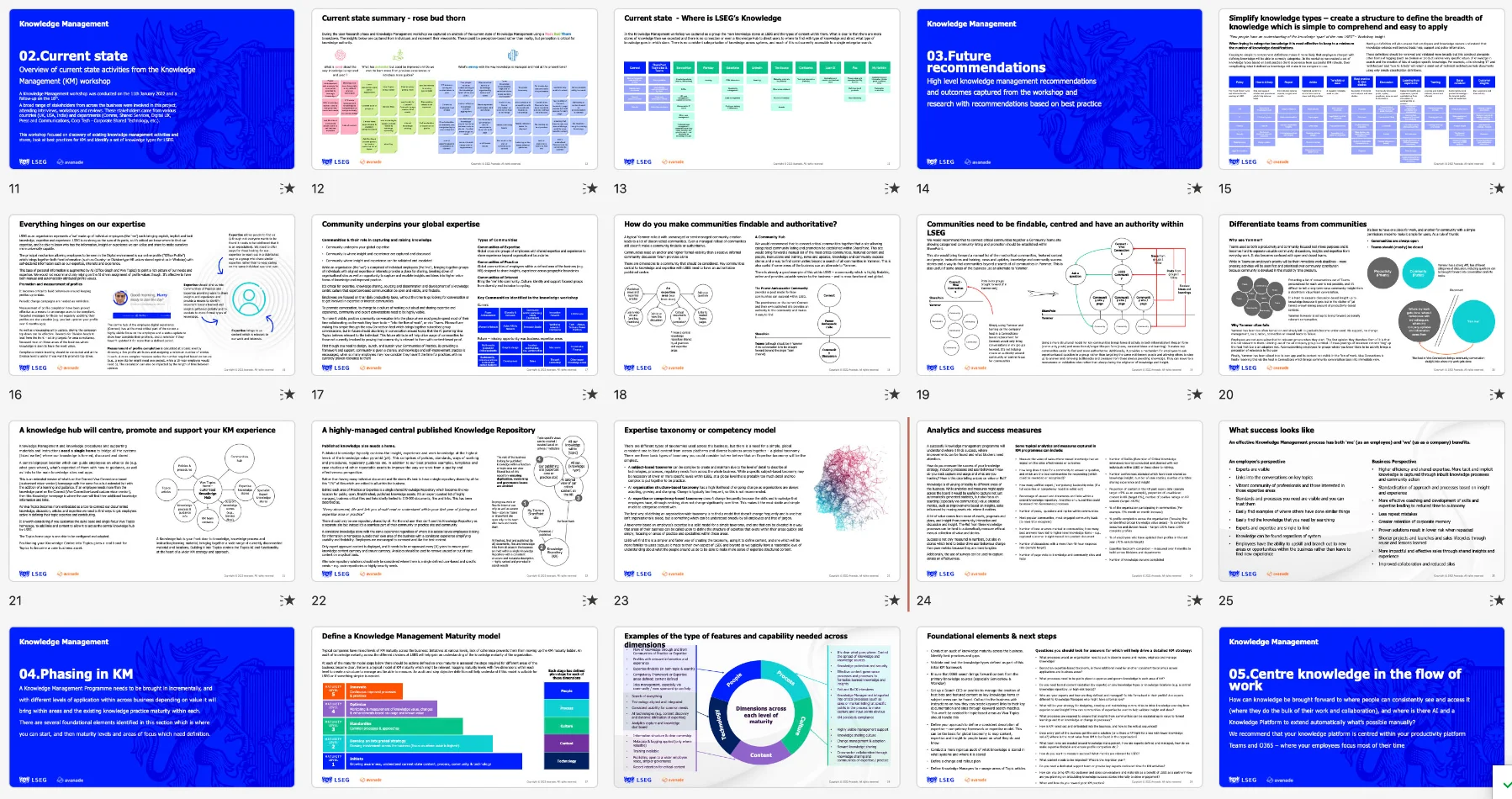
My prior experience carried real weight here, I’ve designed the intranets for some of the world’s largest organisations including Unilever, GSK, AstraZeneca, Sainsbury’s and Shell and designed (under strategist Simon Jewel) Shell’s knowledge management experience, along with knowledge management strategies for British American Tobacco and Glory. That background was critical to covering the full breadth of this vision exercise credibly.
I ran the knowledge management, culture and communications-plan workstreams directly, working with a solution architect on governance. As creative director, I directed visual design sessions with LSEG’s UX and brand team, working with our visual designer Taz to establish the homepage visual design used for brand assurance, which Taz then extended consistently across the other in-scope pages. Alongside the workplace advisory team, Marella and Kheim, and Accenture’s client account lead, Katie, I helped translate research findings and stakeholder input into wireframes, page layouts and component design for the final vision document. I was also closely involved in shaping and selling the work itself, running and attending multiple client presentations and revising the plan and proposal to help land it.
Discover
We followed Avanade’s Discover, Describe, Design co-creation methodology, run across two connected phases. We ran deep-dive sessions with SMEs and stakeholders to understand the current state of Connect and where the biggest opportunities sat and engaged a cross-section of LSEG employees through workshops and interviews to capture how Connect felt today and how people wanted it to feel in future - the direct input behind our personas and the “what your people have said” findings. In parallel, we ran knowledge management and governance interviews to understand existing technical solutions, content, processes and governance models and how knowledge was collected and reused.
Design
We synthesised discovery into five personas with sample journeys and through envisioning workshops with LSEG stakeholders, co-created a vision statement and five employee experience principles, captured in stakeholders’ own words rather than pre-framed around any specific product. That was deliberate: understand what people actually want first, then shape the technology around it. Only then did we map the future workplace onto specific Microsoft 365 products plus ServiceNow and Workday integrations, running separate workshops with those teams on how best to integrate their services.
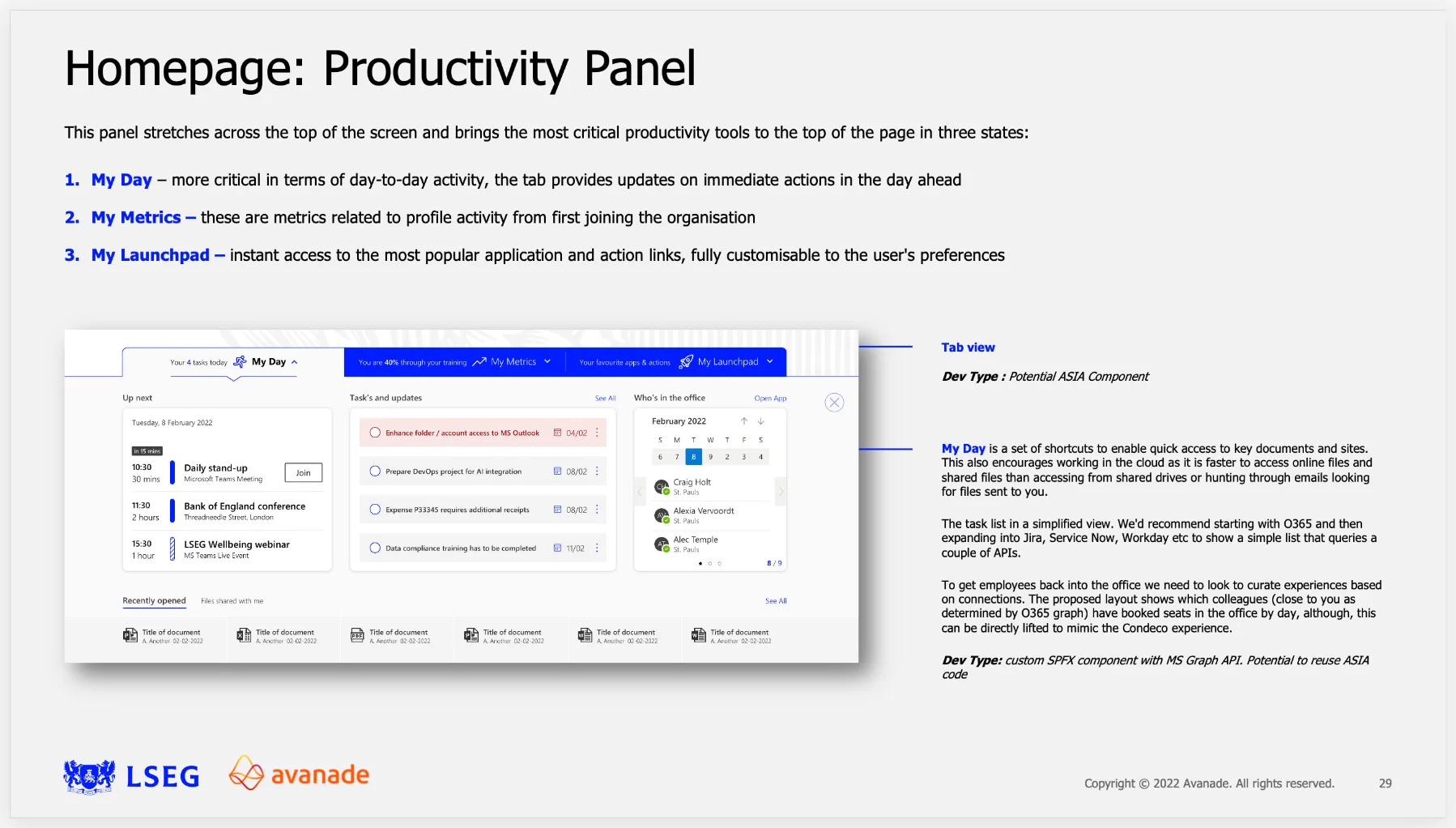
We ran co-design and wireframing workshops covering homepage, navigation, search and key subpages, with component-level design annotations to guide future build. We built five detailed day-in-the-life user journeys, one per persona, to pressure-test the design against real working patterns — from a business leader’s meeting-heavy day to a content consumer approving requests and finding experts through the new Knowledge Hub.
Deliver
We packaged the full body of work into a comprehensive employee digital experience vision document; wireframes, user journeys, integration recommendations and roadmaps, a structure for communication channels (balanced against not over-labouring approvals) and models for user management, governance, personalisation and usage analytics tracking. We user-tested the completed screens, finalised the information architecture using card sorts and tree tests, scoped the whole thing as a single SharePoint homepage and set out a clear delivery plan for LSEG to move from vision into build.
We handed LSEG six connected products: the user research, the personas and user journeys, the co-created employee experience principles, the knowledge management model, the governance and personalisation model and the vision document tying it all together - a complete, evidence-based foundation to build from, rather than a single deck or a scattered list of requirements. Because the vision statement and five experience principles were co-created directly with LSEG’s people, the design carried a mandate that came from the business itself, not one imposed by a delivery team, and employees could see their own representatives had helped shape it.
We delivered validated, wireframed, designed key pages, a visual design treatment and a style guide, ready for build. We gave LSEG clear organisational rationale to consolidate onto a single SharePoint-based homepage, removing the confusion of two competing home experiences for the two merging companies and defined an analytics approach, combining Google Analytics, Power BI and Viva Insights, so LSEG could measure adoption and impact once the experience actually launched. The whole solution was custom-branded but built on an Avanade framework enabling straightforward, low-overhead formatting of SharePoint pages going forward.
One line from an envisioning workshop captured exactly what we were aiming for:
“I know what LSEG needs from me and they give me the technology and the tools I need to do my job.”
Worth being honest about the outcome here: this was a vision and design engagement, not a build. The work was handed to LSEG’s incumbent offshore delivery partner, so I don’t have metrics on adoption or on how faithfully that partner realised the vision, though they did sit in on our workshops and findings playbacks throughout.
What stands out about this project is that, like any project touching a lot of people, it demanded real discipline as a team to stay focused on people rather than product, not on the technology or what any given platform could offer, but on what people were actually asking for, often between the lines. There’s no point delivering a faster horse when what people need is a car. The brief explicitly called for workshops to shape the vision without product overhead and I think we delivered on that well, experience principles are genuinely powerful for keeping a diverse group of stakeholders centred on one shared outcome.
It was a lot to deliver in a short window, as these visioning engagements always are; budgets are tight, sprints are compressed and you must be careful not to over-draw on stakeholders’ time. It also reinforced something important about co-design: you don’t just copy what a stakeholder sketches. You read the hierarchy of information they’ve chosen, how they’ve summarised things, the language they’ve used; all of it tells you what to prioritise and what they’re really reaching for, especially supported by research. This project let me draw on years of prior digital workplace and knowledge management experience and I felt genuinely comfortable speaking as an expert across the whole scope of it.
What I’m less happy about is that we never got to build it. It’s a familiar and frustrating pattern, an incumbent offshore provider quotes low to protect their territory, then makes it back on change requests and procurement ends up choosing the cheapest bid over the most trustworthy delivery partner, even when the customer suspects how it’ll play out. I don’t know whether it was ever built, or built well, but it was exactly what LSEG’s own people asked for, addressing real and significant cultural and connection issues between two very differently rooted companies now trying to become one.