Reimagining marketing as an AI-native, human-centred system
Kyndryl launched an initiative to reimagine its global marketing function as an AI-native, human-centred system, piloting a bold approach to introducing agentic AI into one of the organisation’s most critical revenue growth capabilities.
A move away from piecemeal experimentation with AI point solutions to an AI-native agentic future.
Through systematic discovery, we uncovered both immediate AI opportunities and the foundational process changes needed to unlock them across the entirety of the marketing function.
On this project I trialled the new human systems architect role, working in a small team alongside marketing leadership, CIO teams, OCM and AI specialists to redesign how marketing work is actually done, end to end, rather than simply automating existing organisational-based processes.
This team partnership approach is essential for a successful outcome aligned to operational reality, technical feasibility, human potential and readiness, and successful adoption.
Moving beyond organisation structures to real work
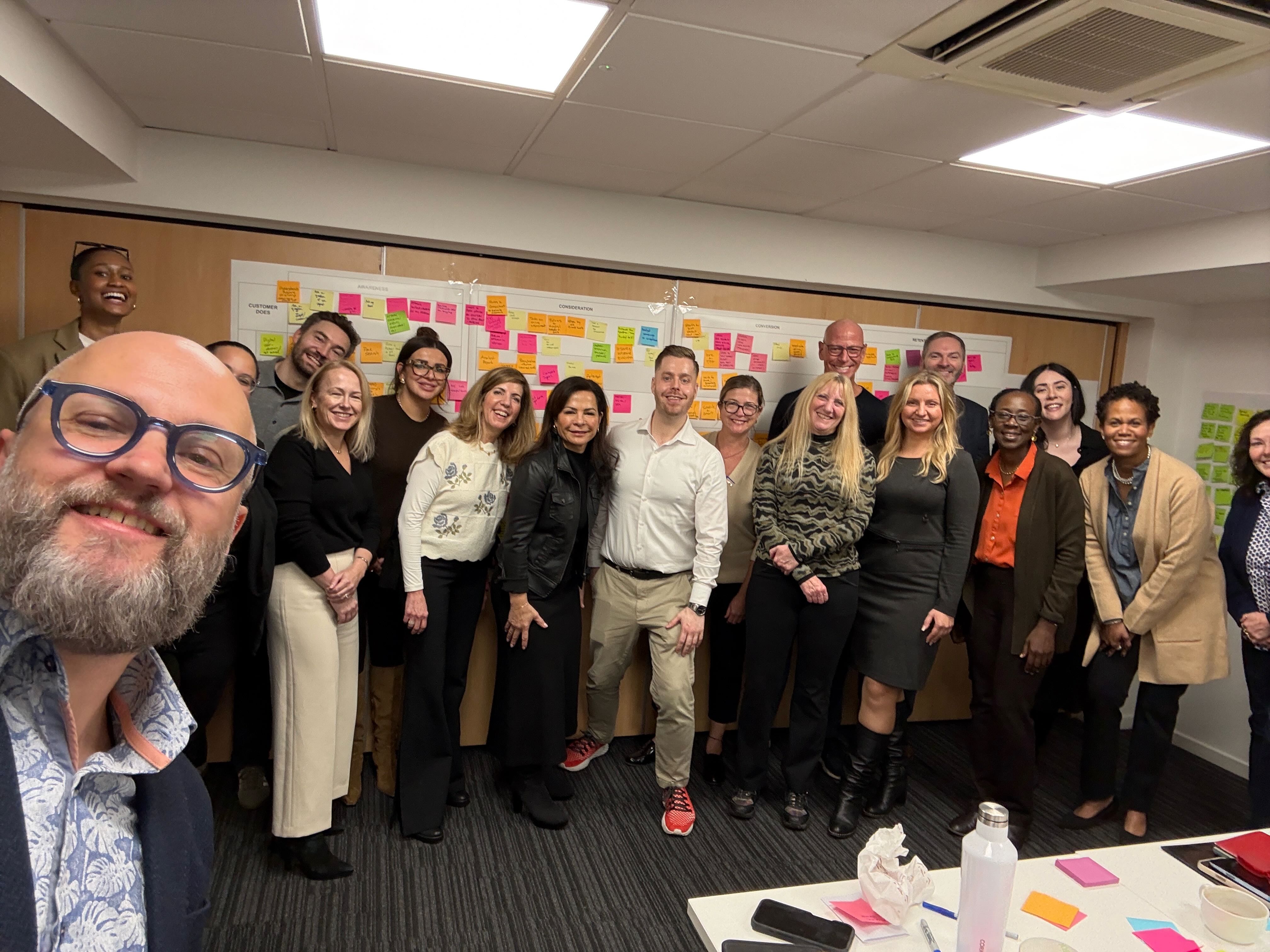
The initiative began with a fundamental question: what does marketing really do? Rather than relying on org charts and structure, which constrains thinking, we convened senior marketing leaders, technology teams, and myself as a Human Systems Architect/Service Designer in an intensive, in-person working session to map marketing as a system of work, processes, outcomes and skills.
Over three days, the team created:
- A detailed view of the current marketing journey
- A proposed future marketing journey
- A full-service blueprint covering frontstage and backstage actions, supported by technology
- A vision for the future of marketing and priorities
This work was reinforced by more than 25 follow-up interviews across marketing and adjacent front-office functions, synthesised to enrich the findings report and next steps.
A clear capability view of marketing
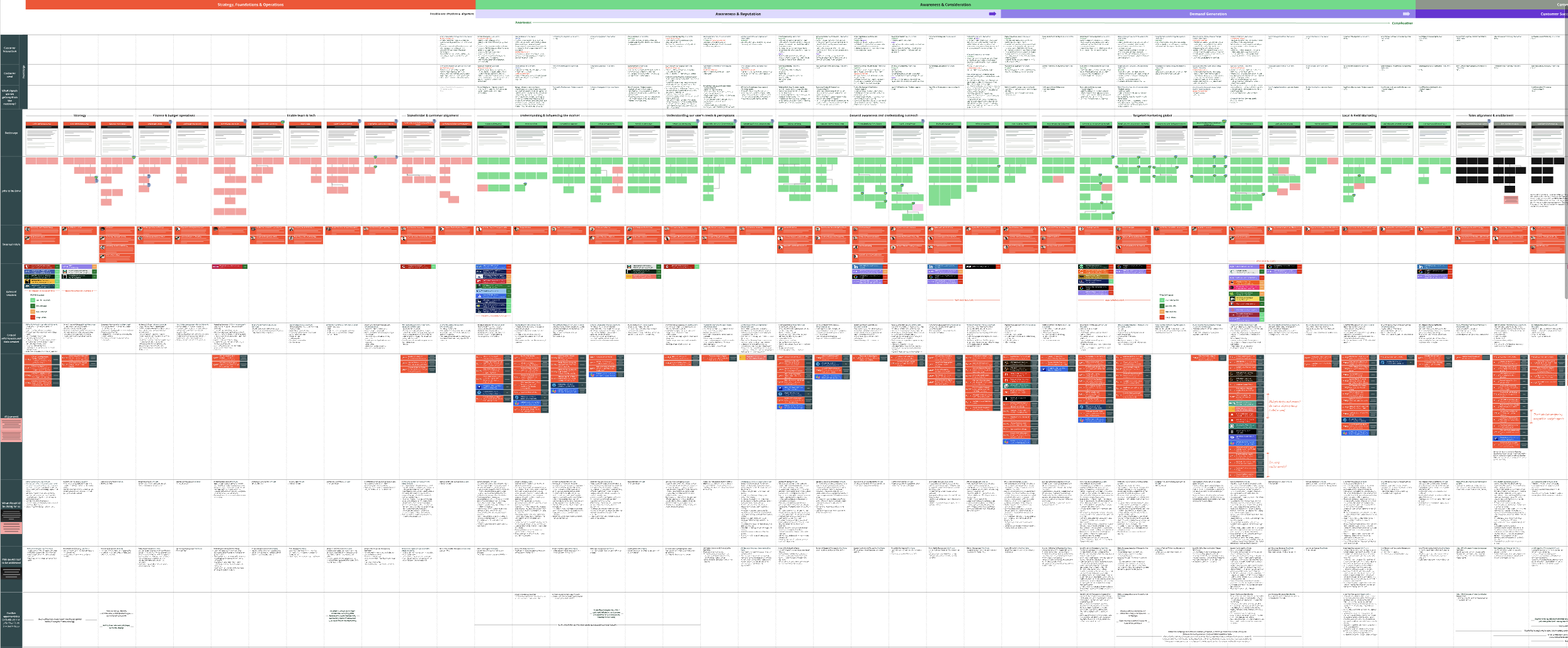
The outcome was a comprehensive, capability-based model of marketing. I identified 52 distinct marketing capabilities, spanning strategy, insight, campaigns, content, digital, sales enablement, bids and proposals, customer intelligence, and performance tracking, right through to revenue impact and client advocacy.
By separating skills from organisational silos, I distilled these capabilities into 18 future skill-based roles, represented as personas to guide redesign of processes, technology and change activities. This included a new AI-specific operational role.
Understanding reality, not just AI potential
The analysis revealed that marketing was already using more than 80 AI-enabled tools and agents, including platforms such as Adobe. However, usage was fragmented and ad hoc. With the exception of content production, AI was not consistently embedded into end-to-end workflows and was rarely operating in coordinated, agentic flows.
The process revealed blockers and process improvement opportunities which need to be addressed, otherwise any automation of existing processes will face the same realities as the current processes. Approval and audit rigour, data unavailability and reliability, trust issues and integration issues need to be addressed. The focus for real AI-led transformation is more than launching AI solutions.
This insight shaped a set of phased recommendations, quick wins, and priorities for deeper transformation.
“Do not automate broken processes. AI adds value only when human, process, and data blockers are addressed first.”
Five priority use cases
To move from strategy to execution, Kyndryl selected five priority marketing use cases:
- 01Campaign marketing
- 02Local sales campaigns and activations
- 03Derivative content production
- 04Executive-level customer insight reporting
- 05Lead management from events
Dedicated internal “pod teams” of marketing doers mapped the current state for each use case, creating a current state service blueprint capturing actions, ownership, timing, data needs, pain points, existing AI usage and approval flows.
The level of detail required for mapping processes can be challenging. Embedding a Human Systems Architect to support the pods significantly improved structure, completeness and consistency of process capture. Without the HSA, the depth needed to progress into reinvention would not have been achieved. This is a critical insight for scaling.
These blueprints informed the design of a single, integrated agentic flow, grounded in how people work today.
From campaign-led to signal-led marketing
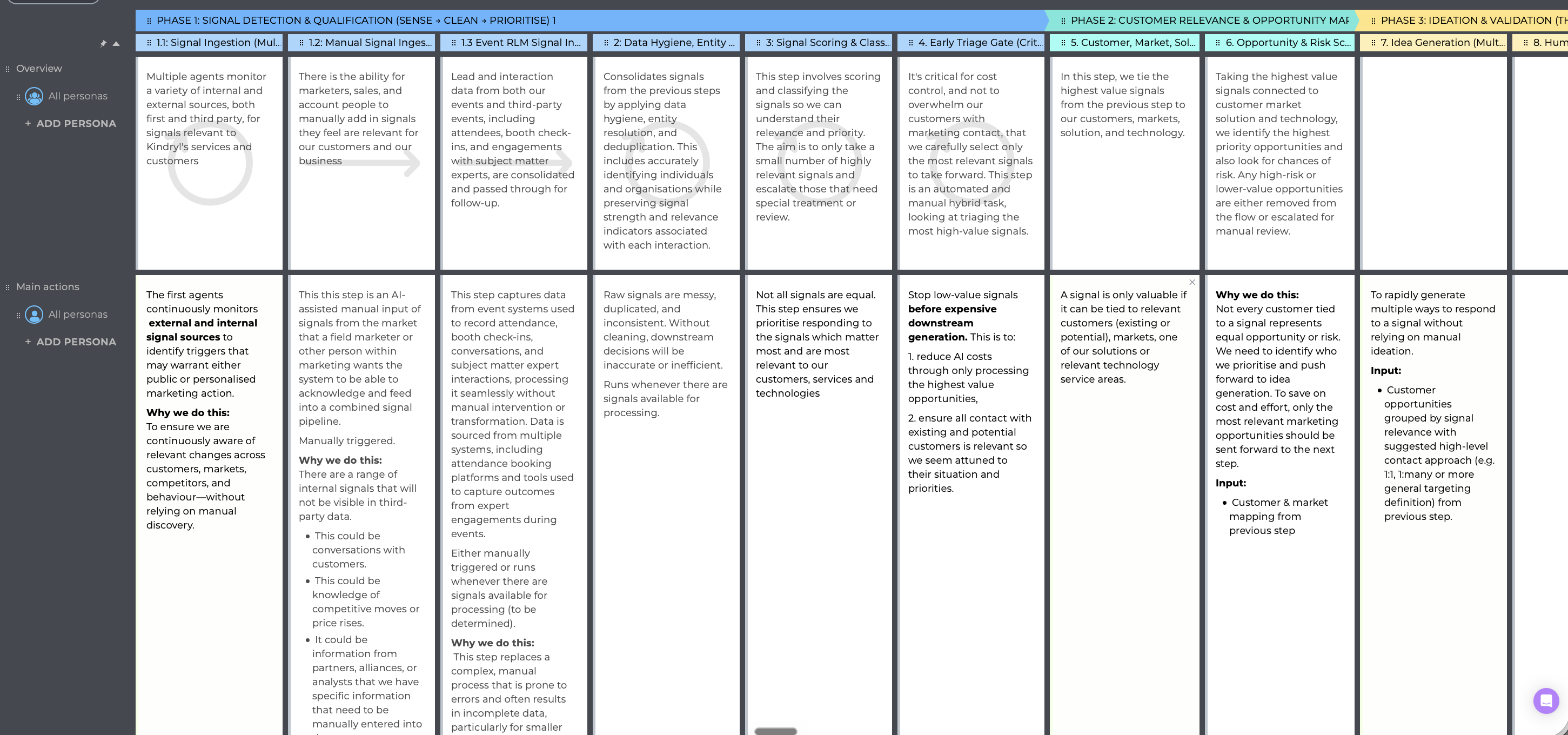
The first agentic capability being designed will shift marketing from traditional, campaign-led execution to signal-led micro-marketing.
Using first-party data, third-party signals, and automated market scanning, Kyndryl will identify high-value intent signals, enrich them with customer intelligence and solution insight and rapidly generate targeted, personalised outreach, always with human validation where it matters most.
Designing trust, not just automation
A new cross-functional reinvention team, combining marketing expertise, CIO leadership, AI architects, builders, and a human systems architect, is now designing this flow in detail. Every step is being assessed for:
- Human vs. agent responsibilities
- Data readiness and quality
- Skill and behaviour impacts
- Trust, validation, escalation and audit needs
- Risk, failure modes and confidence thresholds
- Global vs. local execution requirements
Rather than rushing to scale, the team is working through proof-of-concept builds while enterprise AI frameworks mature, ensuring learning, safety and quality are built in from day one.
A measured path to AI-native marketing
The work has reinforced a key insight: most organisations are not yet ready to operate at the “speed of intent” implied by AI ambition alone. Existing processes, data maturity, content readiness and human concerns can all limit outcomes if not addressed early.
By taking a human-centred, systems-design approach, Kyndryl is surfacing barriers early, reducing risk, and ensuring that new AI-enabled processes raise quality and performance, rather than undermining them.
What we learned
- 01User engagement is critical. Bring users directly into the design so they will co-own, test and ultimately adopt the tools and processes needed to move toward an AI-native capability.
- 02C-level and executive support was critical to establishing and operating this broad transformation programme.
- 03Specialist, compact expert teams leveraging internal expertise, combining workshopping, research, interviews, organisation change and people readiness with engineering expertise, are an efficient and effective means to quickly understand and define the opportunity and challenges.
- 04Marketing transformation starts with understanding work as a system, not defined by its current organisational structure.
- 05Agentic AI delivers the best value when embedded into end-to-end human workflows.
- 06Human validation, trust, and escalation are essential, not optional, in AI-driven marketing.
- 07Capability-led design enables clearer skill, role and technology decisions for broad transformation.
- 08Linking personas to capabilities and agentic flows allows us to better support our people to adopt and excel within the new processes.
- 09Do not automate broken processes. AI adds value only when human, process and data blockers are addressed first.
- 10Proof-of-concepts allow progress without over-committing before foundations are ready.
Not replacement.
Over impulsive automation.
AI allows us to become a signal-driven marketing organisation as a strategic differentiator.
To reduce risk and accelerate learning.
As first-order design concerns.
Benefits of a human-centred approach to agentic marketing transformation
Taking a human-centred approach enables organisations to:
- Align AI capabilities with real human decision-making, context and judgment.
- Capture the implicit and tacit insight and information inherent in human processes, which is critical to successful AI design. Without a human-centred approach, missing this insight will lead to process inefficiency or failure.
- Support SMEs and doers to define the right level of data and insight needed to reinvent ways of working.
- Identify process, data and content readiness gaps before scaling investment.
- Build trust in AI outputs through clear validation and escalation mechanisms.
- Protect business continuity and quality during transformation.
- Avoid premature role displacement and unintended organisational harm.
- Ensure that the human users in the process are equipped for success and prompted with the right insight and context to play a meaningful role. It’s critical that human involvement isn’t simply a checkpoint, but a value-adding step for a true human/AI partnership.
- Design agentic systems that truly augment human capability and impact.
By orchestrating humans and AI as a cohesive system, rather than rushing to automate, Kyndryl is laying the foundation for a scalable, responsible and high-impact AI-native marketing function.