Is Your Business Ready for Agentic AI?
Redesign, Reinvention and the Case for Human Systems Architecture
Where do you start and what changes when the future state isn’t yet defined?
Before exploring how the Human Systems Architect (HSA) role should adapt to different levels of organisational readiness, it’s worth naming three realities we consistently encounter on the ground.
1. Change is difficult (no surprise!)
A further practical challenge is limited ability to implement change and technology at pace. Although many stakeholders and implementors may attend meetings from technical and governance teams, progress can often be slow, data inputs incomplete and only a small subset of people tend to actively contribute. Content and systems remain misaligned and ad hoc, with constraints around system of record, content management, security and compliance acting to slow progress (albeit for good reason). The result is frequent compromise on the original vision and desired outcomes, leading us to move to a PoC model rather than transformative change. Change resistance is as much readiness-based as it is human.
We need to ensure our work does not inadvertently reflect negatively on our stakeholders. Current-state views documented can be rejected as “inaccurate,” partially because they can be perceived as unfavourable (“you’re not showing that to my boss!”). We should adopt a more considered approach to framing messages and current state; otherwise, there is a risk that recommendations will be hidden.
2. The perception of instant AI
In my own HSA work, I have encountered the expectation that this entire level of rigour could be delivered “within two weeks” across multiple use cases. This highlights an inherent tension between speed of demand, methodological thoroughness and organisational capability. Many organisations are rushing to deploy AI, and as a result we may need to define accelerated paths or phased approaches that allow value to be delivered iteratively or be clear about the duration required - AI takes time to implement properly. A few-week sprint can be a valuable tool for setting expectations around process design/re-design duration, but development could take much longer, which is a difficult message to convey. The Human Systems Architecture definition makes this complexity clear.
3. Too many initiatives, too many disconnected streams
There is also a need to manage aspiration carefully. Organisations face too many AI initiatives and there’s real potential for AI to generate excessive content. While ideas abound, capacity for build, data readiness and foundational maturity remain limited and managed prioritisation is critical - this could be an additional opportunity for more senior HSAs in prioritisation and in defining the way businesses operate and their people lead and orchestrate.
Redesign vs. Reinvention
These three realities point to the same underlying issue: not every business is starting from the same place and not every engagement calls for the same approach. The clearest way to separate the two is the distinction between process redesign and process reinvention.
Read: What is a Human Systems Architect? →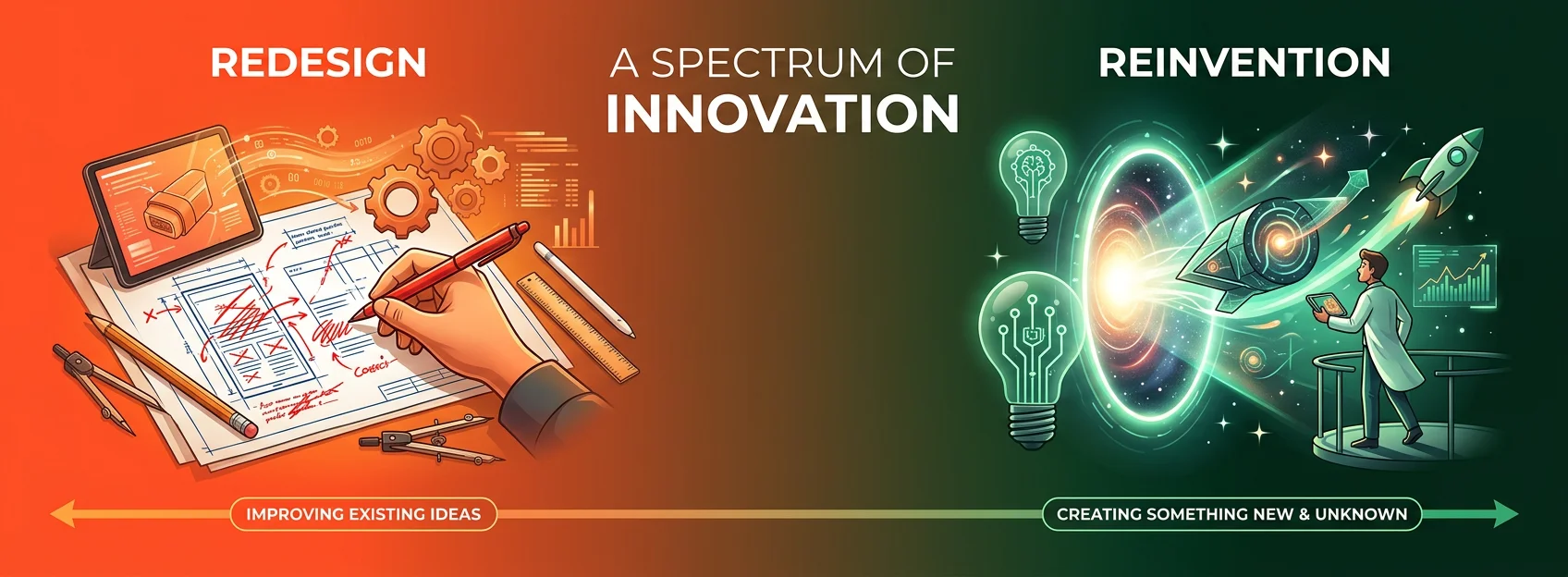
Implications for method and process capture
When a process already exists and is well understood, a structured process map is usually the right place to begin. Roles are known, the flow is fixed and the main design challenge is to decide how human effort, controls and AI automation should be redistributed. In this context, formal process diagrams and swim-lane views are effective because they reflect a stable operating reality that stakeholders already recognise and can easily handle the detail needed to complete.
For process reinvention, the design process is much looser at the outset. Highly structured process maps can become limiting if the organisation is still exploring what the process could become. In these cases, more conceptual and workshop-based approaches are often more useful early on. Rather than beginning with fixed roles and task allocations, the work may start with brainstorming, capability design, future-state scenarios and collaborative exploration between domain experts, HSAs and AI specialists.
Implications for the HSA role
This distinction also raises an important question about the boundary of the HSA role. Much HSA work appears to sit most naturally in process redesign, where the challenge is to redesign human and AI interaction within a known business process. Process reinvention starts to overlap with broader business redesign, strategy and consulting work, because it may involve redefining how a function operates rather than only how a process is executed.
That suggests a spectrum of HSA capability. Some HSA assignments are largely operational and method-driven; others require more senior, conceptually oriented practitioners who can work in more ambiguous environments and engage with business leaders on future-state operating models, organisational implications and change narratives.
This could also include identifying the human impact of AI-driven changes, such as planning what happens when people’s time is freed up through automation. It involves defining how individuals can be redeployed into higher-value, more beneficial activities as routine, mechanical tasks are automated and greater insight and decision support are placed in their hands.
HSA is well suited to ideation and definition in this space, but there is a strong interdependency with Change and Workforce Transformation teams. Any localised changes resulting from process redesign or reinvention will often form part of a broader organisational transformation.
Documentation approach adapts with the scale of change
The most significant difference between process redesign and process reinvention is the extent to which the client already understands the world being changed.
In process redesign, clients know their existing process (at least at a high level). Their main concerns are usually whether risks are controlled, standards are maintained, errors are prevented and operational performance is improved. Because the process is familiar, they do not need extensive storytelling to understand the proposal; they mainly need confidence that the redesigned version will work safely and reliably.
Process reinvention is different because the proposed future state may be unfamiliar to the client at a very practical level. If the recommendation introduces a radically different way of working, stakeholders may struggle to picture how it would operate day to day - how people would work, what they would do, what new roles are needed, how decisions would be made, or how the change would affect current roles. In those situations, a technically correct recommendation is not enough. The design must also be made understandable, credible and discussable.
A bold proposal, even when grounded in strong evidence, can be rejected if the client cannot see how it would translate into real work inside the business.
Without a clear narrative showing what changes for people, how the future process operates and how the organisation can move from the current state to the future state, the perceived risk becomes too high. The lesson is that reinvention requires not just analysis and recommendation, but interpretation and explanation – storytelling.
For that reason, documentation should vary according to the scale of change. A relatively contained redesign of a known process may need concise process documentation, clear controls, role definitions and implementation detail. A reinvention initiative needs more than a process map, it requires richer explanatory material that helps stakeholders understand what is changing, why it is changing, how new human and AI roles work together and where the approach may succeed or fail in practice.
In particular, reinvention documentation should help the business understand the following in narrative terms, with examples:
- How roles and responsibilities will change
- What new skills or personas will be needed
- How the future process will be governed
- Where key risks, dependencies and likely failure points sit
- What the future-state workflow looks like in practical, human terms
Implications for delivery and phasing
In process redesign, it is often reasonable to move relatively quickly from design into build, because the target state is an evolution of something the client already understands. The core requirement is to define the process in enough operational detail for implementation, control and adoption.
In process reinvention, an immediate move into build is much less likely. The client usually needs time to absorb the implications, debate the proposal, test whether it is acceptable and understand the organisational consequences. They then need to land the concept with their technology and security people, all of which takes time. This means the methodology should include explicit phasing, or recommended methods for exploration, narrative explanation, stakeholder review and future-state validation, before implementation is considered.
Reinvention requires additional layers of design detail
One practical implication of reinvention is that it often requires additional layers of documentation, moving from broad capability design down to specific multi-agent workflows. In my work with marketing reinvention, this layering looked broadly like the following:
- 01First, we defined marketing as an end-to-end set of capabilities, independent of organisational structure. From this, we identified sixteen core skill sets required to deliver these capabilities, which were developed into personas.
- 02Secondly, we explored agentic processes that operate across these capabilities to deliver end-to-end value, either as new processes or as evolutions of existing interconnected processes. This included a new type of automated signal-based marketing, selected because it spans multiple capabilities and introduces a new operating model for the organisation.
- 03We then facilitated the design of a new process through workshop ideation, encompassing a broad cross-section of marketing capabilities, from intelligence through to analytics - informal and rapid iteration.
- 04To support stakeholder engagement, this process was documented in a narrative format, recognising that the process diagram was not easily understood by our intended business audience. The narrative version allows AI interaction (defined using Miro’s amazing AI tools and the Service Blueprint as an LLM) to help define a new Marketing AI Orchestrator role.
- 05Finally, we are developing a Service Blueprint or Process Canvas, capturing all required elements in line with Kyndryl’s core HSA framework.
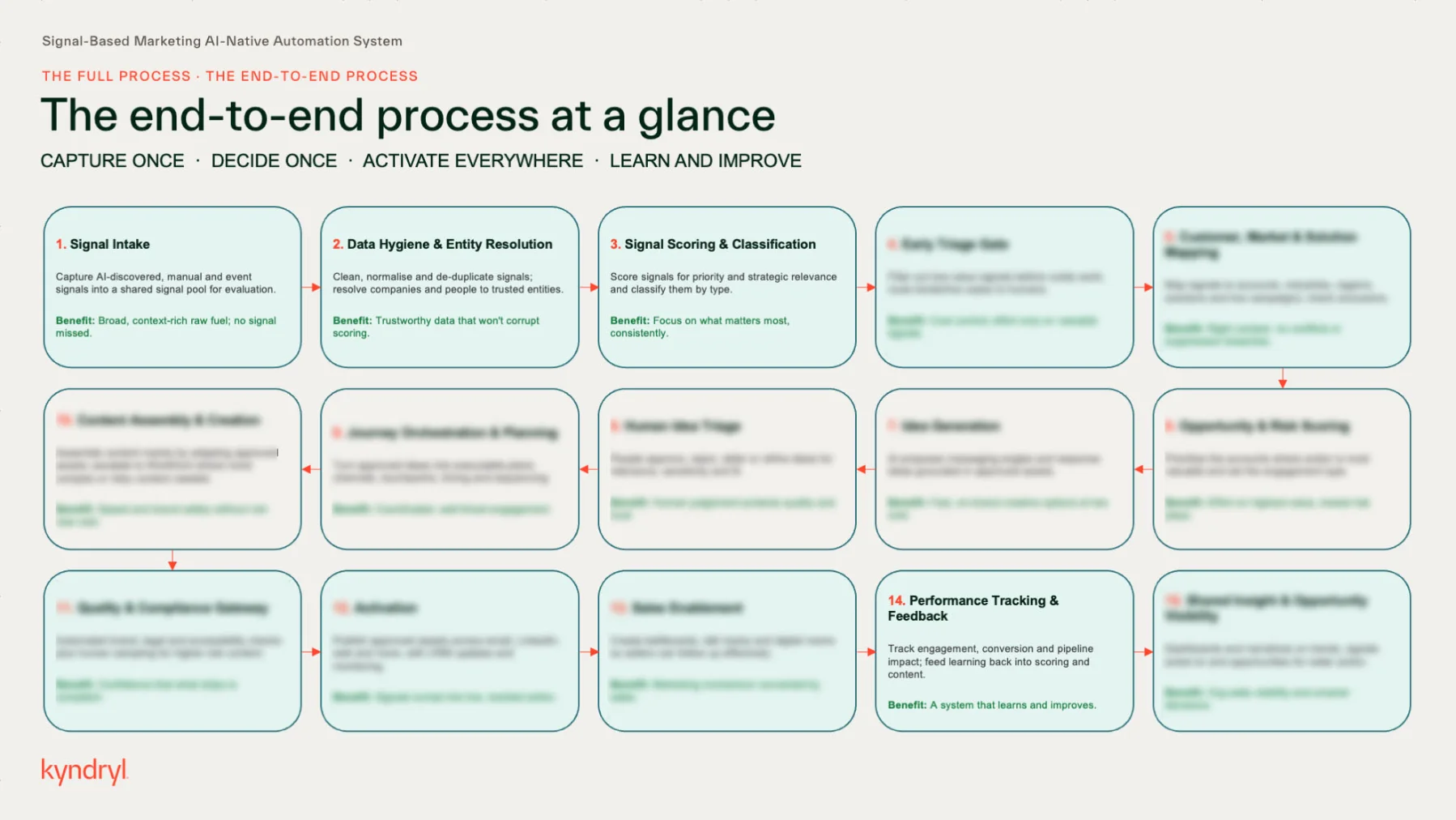
Reinvention work requires documentation that can explain a future operating model at several levels, from strategic intent through to practical execution. This view shows a high level process journey for C-level briefing. Documentation then dives into detail right to a 42,000 word detailed definition at the implement end.
A key question is how the HSA role can be positioned in organisations that are not yet prepared for significant AI automation or organisational change, in other words, organisations that need reinvention before they’re ready for redesign.
This could be a substantial portion of enterprises. As we’ve found through our own AI transformation, it can prove more difficult, time-consuming and costly than expected. How can we demonstrate the art of the possible by defining how a company could evolve its business, as well as its people’s skills and roles, ideally in partnership with Forward Deployed Engineers demonstrating potential in real-life PoCs?
What happens if customers are unprepared for HSA process definition?
What happens if a customer’s readiness for agentic design is restricted by data limitations, organisational constraints or governance issues and anticipated demand doesn’t materialise? One approach is to work with customers to envision the future of human-AI interaction, while simultaneously identifying what foundational capabilities must be established first. HSA design and delivery methodology should be able to adapt to a variety of customer readiness levels.
Preparing the methodology for low-readiness organisations
Rather than immediately assuming design-ready, detailed processes, the HSA methodology should include elements focused on identifying gaps, priorities, readiness thresholds (beyond people capability) and prerequisite actions. This enables organisations to build a clear picture of how AI and people should work together, even before detailed process definition begins, or before the organisation is ready.
When do you need a senior Human Systems Architect?
Senior HSAs can operate as strategic conductors, helping organisations understand how AI and humans work together at a systemic and strategic level, rather than designing isolated agentic flows or continuously designing technology point solutions. This is why there is a strong alignment between Service Designers and the evolving HSA role: similar discovery, envisioning and definition activities are common to both, with process design as an extra ability many Service Designers already have experience with.
Data-driven opportunity identification is valuable but often insufficient. Many stakeholders struggle to envision future operating models from analytical insight alone. Senior HSAs can define a broader, narrative-driven transformation view: examining the entire function, abstracting away silos, defining capabilities and skills and identifying high-value AI interaction points. This helps align on a customer’s definition of “transform” in a way they can relate to their business.
This creates space for senior HSAs to operate in a more strategic, sales-adjacent role; shaping vision, setting priorities and engaging users early to build champions before detailed methodology execution begins. Telling stories and demonstrating scenarios familiar to stakeholders is central to this.
These activities are well suited to customers with limited capacity for large-scale, AI-driven transformational change. They enable extended customer engagements and a sustained pipeline of follow-on work as customer intent matures to align with readiness for change.
There are shared and aligned roles in determining opportunity and strategic recommendations for AI-led transformation. Senior HSAs deployed in visioning, strategy and persona-definition work can create longer-term transformation objectives that feed pipelines for more junior HSAs, alongside colleagues in aligned roles.
Commercial and pipeline implications
From a commercial perspective, there is a risk that a narrow focus on shorter multi-week sprints won’t generate sustainable demand to maintain an HSA practice at scale. HSA demand may decline if HSAs don’t act to define their own pipeline — especially by identifying and scaling engagements at existing customers where longer-term work is already in progress.
We must also challenge the market perception that AI inherently equals speed. AI adoption can introduce additional complexity depending on organisational maturity, and in some cases it might even add delays to adoption as we wait for an official, unified, common solution to build upon. A senior HSA mapping out a larger business process — including ad hoc and informal AI use — could advise on what to continue or expand in the short term, until the business is ready and has had time to design and build formal systems and processes.
There is an opportunity to stimulate demand for additional teams and services. Early engagement suggests many customers may initially pursue proofs of concept or single-process pilots to validate approaches. While limited in scope, these often signal a broader appetite for transformation - one that requires organisational, workforce and performance changes, which take time to define and implement. An example is the adoption of AI usage as a people-performance measure, as seen in approaches taken by Accenture and others.
To capitalise on this, HSAs must be equipped with clear messaging and targeted content that lets them effectively position and sell complementary services, particularly those adjacent to and enabled by our work. Any People & Performance, Workplace Strategy or Organisational Change team should be viewed as a potential demand stream and supported with simple, consistent selling messages that reinforce and identify HSA opportunities. HSAs also need to align with Consulting, Business Advisory and Service and Experience Design practices, to understand whether we can be involved in their work pre-process design and help shape vision and change within our customers. The earlier we get into an opportunity, the more likely it is to eventuate.
Finding the highest-value starting point
Before entering the core HSA activities, there needs to be explicit pre-work to determine which processes offer the highest potential value for redesign. In work with Kyndryl Marketing, this kind of intentional scoping proved essential to map out a pipeline of opportunity. This allows us to use a broader HSA delivery beyond a pre-identified process scope and helps avoid a process-by-process approach once we understand the broader scope of transformed processes and services.
There are data-driven value identification approaches using public datasets to infer task-level AI potential, but data alone often fails to resonate with business stakeholders, who want to see and understand how their organisation will change through human-AI collaboration, and to hear a narrative view of how their business will change and their people will adapt.
An alternative or complementary approach is the use of Service Design methods to uncover opportunity, as demonstrated in the Kyndryl Marketing work. This represents a substantial opportunity aligned to the senior HSA role at a more strategic level.
Processes which are not ready
We must also determine whether existing processes require improvement before automation is designed in. AI will not fix fundamentally broken processes or human delays. Working at a broader scope allows organisational and cultural barriers, such as audit, procurement and brand constraints, to surface early. Critically, working in a combined HSA, FDE and industry SME team helps define responsibilities and solutions.
Focus on ‘who’ before ‘what’
Capturing the “who” detail in process design is critical. In the marketing work, everything Marketing does was decomposed into 52 capabilities and subsequently 16 skill-based personas were defined to deliver these capabilities, as well as a new future Marketing AI Operations role with a clear list of responsibilities, tasks and attributes for role development and laddering progression definition - a task for workplace and HR specialists.
This provided far more clarity on the “who” than simply relying on organisational charts, which are both misleading and restrictive, or on an undefined or minimally defined “user” who may mean different things to different people. Defined personas, disconnected from formal structures, facilitate clearer change-definition efforts, including defining new orchestration roles. In Marketing, as is common to many customers, skills are duplicated across the organisation or inconsistently scattered, so org-chart-agnostic personas are critical for truly agentic flows.
There is a critical handover to OCM of persona information, as they can refine and evolve it with the customer and create change plans, or work with workplace transformation and HR to design roles and train people.
Additional pre-HSA considerations
- Understanding where and how a process fits within the broader enterprise or functional ecosystem, for broader context and opportunity
- Validating or helping select use cases that deliver the greatest value
- Validating use cases with stakeholders and end users, to identify unstated barriers or process issues that need to be resolved or improved prior to process design/re-design
- Defining users beyond job titles: capabilities, skills, experience and background
- Quantifying the cost, duration and effort of current-state processes for benchmarking
- Prioritising use cases before detailed process definition begins
Not every business is ready for the same conversation about agentic AI. Some need a faster, redesign-led path within a process they already understand; others need the slower, narrative-led work of reinvention before a process even exists to redesign.
The HSA’s job (and the job of every customer-facing person) is to recognise which one is in front of them and to have a methodology, a documentation approach and a commercial model flexible enough to meet it using the right person with the right approach.